

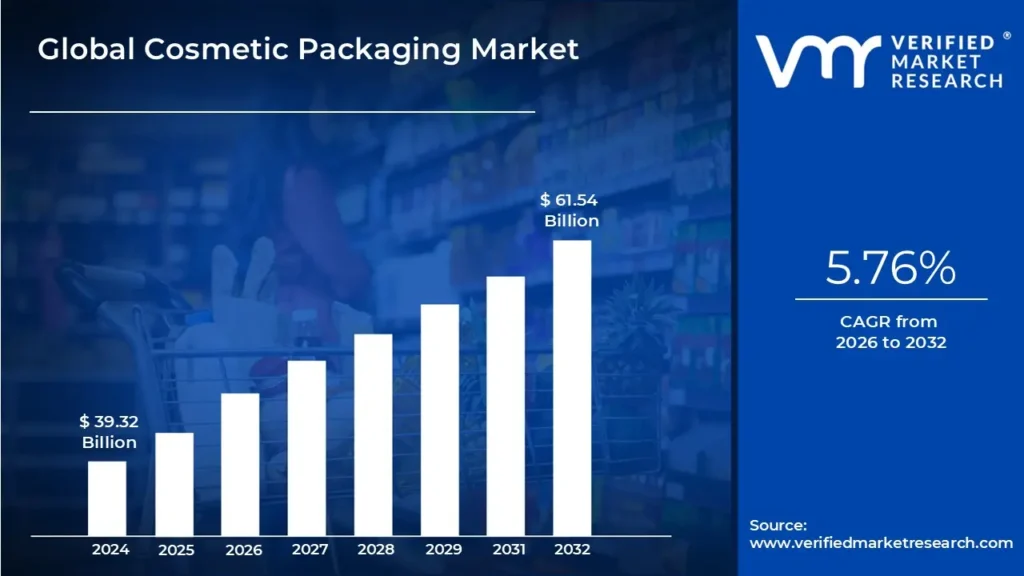
Cosmetic Packaging Market Size Set to Reach USD 61.54 Billion by 2032, Growing at 5.76% CAGR on Rising Demand for Premium and Sustainable Packaging Solutions: Verified Market Research
Global Cosmetic Packaging Market industry is expanding steadily as brands prioritize premium aesthetics, sustainable materials, and e-commerce-ready designs. Rising disposable incomes and consumer demand for personalized, protective packaging are reshaping product strategies across skin care, hair care, makeup, and nail care segments. Plastic continues to lead by material while tubes dominate by product type, even as glass, paper, and metal carve out specialized, high-growth niches. Verified Market Research® projects continued Cosmetic Packaging Market growth through 2032, led by Asia-Pacific's expanding manufacturing base and North America's technology-driven innovation.
LEWES, Delaware, July 10, 2026 (GLOBE NEWSWIRE) -- The Cosmetic Packaging Market size was valued at USD 39.32 Billion in 2024 and is projected to reach USD 61.54 Billion by 2032, growing at a CAGR of 5.76% during the forecast period 2026 to 2032, according to a new report published by Verified Market Research®. The report offers a comprehensive Cosmetic Packaging Market analysis covering material types, product formats, applications, and regional demand patterns, providing stakeholders with a detailed view of Cosmetic Packaging Market growth drivers, restraints, and competitive dynamics through the forecast period.
 Download a free sample to access exclusive Insights, Data Charts, And Forecasts From Cosmetic Packaging Market Sample Report
Market Overview
The Global Cosmetic Packaging Market encompasses the manufacturing and distribution of containers and materials used to store, protect, and present cosmetic and personal care products. The scope of the Cosmetic Packaging Market includes primary packaging, which is in direct contact with the product such as bottles, jars, and tubes, as well as secondary packaging, which forms the outer wrapping such as boxes and cartons. This dual scope reflects the full journey of a cosmetic product from manufacturing through to the point of consumer use.
Packaging within this industry is no longer a purely functional element. It has become a strategic marketing tool that shapes consumer perception and influences purchasing decisions through design, color, and material choice. At the same time, packaging retains its foundational purpose of preserving the quality, integrity, and shelf life of cosmetics by protecting formulations from physical damage, light, air, and other environmental factors. The Cosmetic Packaging Market therefore sits at the intersection of brand strategy, product science, and evolving consumer expectations around sustainability and convenience, including the accelerating shift toward e-commerce.
The report's scope is defined along four segmentation dimensions: Material, Product Type, Application, and Geography, giving brand owners, packaging manufacturers, and investors a structured basis for evaluating where Cosmetic Packaging Market growth is concentrated and where competitive intensity is highest.
Key Growth Drivers
Verified Market Research® identifies eight primary forces shaping Cosmetic Packaging Market growth, spanning consumer behavior, regulation, and technology.
- Rising Demand for Premium Cosmetics: Escalating consumer preference for high-end and luxury beauty products is a significant catalyst for the market. As purchasing power increases, consumers are willing to invest in premium products offering superior quality and an elevated experience, driving demand for packaging with sophisticated designs, high-quality materials such as glass and metal, and details like embossing, unique finishes, and custom shapes. This aesthetic and tactile focus helps justify higher price points while fostering brand loyalty.
- Growth of E-commerce and Online Retail: The rapid expansion of e-commerce has reshaped the packaging landscape by requiring containers to serve a dual purpose: withstanding the rigors of shipping while delivering a compelling unboxing experience. This has increased demand for protective yet aesthetically pleasing packaging, with brands investing in custom inserts, elegant boxes, and personal touches that turn delivery into a memorable event.
- Increasing Focus on Sustainability: Growing environmental awareness among consumers and brands is influencing every stage of the packaging lifecycle, from material sourcing to end-of-life disposal. This has led to wider adoption of eco-friendly, recyclable, and biodegradable materials, including post-consumer recycled (PCR) plastics, glass, and paper-based packaging, alongside innovations such as refillable systems and mono-material designs that simplify recycling.
- Technological Advancements: New functionalities are enhancing both product integrity and consumer engagement. Airless containers extend shelf life by preventing oxidation and contamination, a critical concern for natural and active-ingredient formulations. Smart packaging featuring QR codes and Augmented Reality gives consumers instant access to product information and brand stories, while 3D printing enables highly customized designs without traditional mass-production limitations.
- Rising Disposable Incomes: The global rise in disposable incomes, particularly in emerging economies, is fueling demand for beauty and personal care products as more consumers enter middle- and high-income brackets. This is creating a large new consumer base receptive to a wider range of products and packaging formats, prompting cosmetic companies to expand offerings that convey quality to new generations of beauty consumers.
- Shift Toward Personalization: Consumers are increasingly seeking products and packaging that feel unique and tailored to their individuality. Brands are moving beyond one-size-fits-all solutions toward customized packaging options, ranging from personalized labels to fully customizable designs where consumers choose colors, textures, or add personal messages, deepening emotional connection with customers.
- Regulatory Push for Safer Packaging: Stricter global regulations on packaging safety and labeling are compelling manufacturers to ensure materials are non-toxic, do not react with the product, and are free from harmful chemicals such as PFAS. Greater emphasis on clear and accurate labeling is pushing brands toward advanced, compliant packaging solutions, ultimately building consumer trust.
- Brand Differentiation and Marketing: In a saturated market, packaging has evolved into a key marketing tool and a primary means of brand differentiation, often serving as the first physical interaction a consumer has with a product. Innovative shapes, vibrant colors, and unique materials allow brands to instantly communicate their values, whether through minimalist elegance, playful design, or eco-conscious materials, achieving competitive advantage on the retail shelf.
Download a free sample to access exclusive Insights, Data Charts, And Forecasts From Cosmetic Packaging Market Sample Report
Emerging Opportunities
Building on these growth drivers, several opportunities stand out for participants in the Cosmetic Packaging Industry. The convergence of sustainability and premiumization is opening opportunities for brands that can offer recyclable, biodegradable, or refillable packaging without compromising the luxury aesthetic associated with high-end cosmetics. The expansion of smart packaging, including QR codes, NFC tags, and Augmented Reality integration, presents an opportunity for brands to deepen consumer engagement and provide product transparency at the point of purchase.
The continued growth of e-commerce beauty platforms creates opportunities for packaging suppliers specializing in durable, transit-ready formats paired with premium unboxing experiences. Additionally, the rise of indie beauty labels and influencer-led promotions, particularly in Asia-Pacific markets such as South Korea, Japan, and China, is creating opportunities for packaging innovation tailored to smaller-batch, design-forward cosmetic brands. Compact, travel-friendly packaging formats also represent a growing opportunity as on-the-go lifestyles influence purchasing patterns across regions.
Market Challenges and Restraints
- High Cost of Sustainable Materials: Sustainable options such as post-consumer recycled plastics, biodegradable polymers, and glass are typically more expensive to produce and process than virgin plastics. This cost premium is often passed on to brands and consumers, creating tension between sustainability goals and affordability, particularly for mass-market products where price sensitivity is high.
- Stringent Regulatory Requirements: The sector is subject to a complex web of national and international regulations covering chemical safety, migration into products, labeling accuracy, and environmental disposal, enforced by bodies such as the FDA and the European Union's REACH and CLP frameworks. The frequent evolution of these rules necessitates constant investment in compliance, which can be prohibitive for smaller companies.
- Fluctuations in Raw Material Prices: Heavy dependence on plastics, glass, aluminum, and paper exposes the industry to volatility from geopolitical events, supply chain disruptions, and economic shifts, such as fluctuations in petroleum prices that directly affect plastic manufacturing costs. This unpredictability complicates long-term planning and can strain profit margins.
- Environmental Concerns Over Plastic Usage: Despite its versatility, low cost, and durability, plastic faces growing scrutiny amid rising concern over plastic waste. Government bans on single-use plastics and more conscious consumers are forcing the industry to re-evaluate reliance on plastic, limiting growth opportunities for traditional plastic-based packaging.
- High Competition and Market Saturation: The market features a mix of large multinational corporations and numerous regional and local players, leading to pricing pressure and margin erosion as companies engage in price wars to win contracts, making differentiation beyond price a persistent challenge.
- Supply Chain Disruptions: Global supply chains supporting raw material sourcing and product distribution remain vulnerable to natural disasters, geopolitical tensions, trade disputes, and public health crises, which can cause raw material shortages, production delays, and increased transportation costs, particularly affecting smaller manufacturers without redundant supply chains.
-
Short Product Life Cycles in Cosmetics: Rapid product innovation and frequent launches driven by fast-changing consumer trends require packaging companies to be agile, continuously investing in new molds, designs, and production lines, which increases operational costs and complexity while creating inventory management challenges.
Technology and Innovation Trends
Innovation is a defining feature of the Cosmetic Packaging Market Growth trajectory. Airless container technology is extending shelf life by preventing oxidation and contamination, an important consideration for formulations built around natural and active ingredients. Smart packaging, incorporating QR codes and Augmented Reality, is giving consumers instant access to tutorials, product information, and brand storytelling directly from the container. Meanwhile, 3D printing is allowing brands to produce highly customized, intricate packaging designs without the constraints of traditional mass production, supporting the broader industry shift toward personalization.
On the materials side, innovation is centered on recycled, recyclable, and bio-based options, including post-consumer recycled plastics and mono-material designs that simplify recycling streams. Refillable systems are also gaining traction as brands look to reduce single-use packaging waste while maintaining premium presentation. In Europe specifically, integration of QR codes and NFC tags into packaging is enhancing consumer engagement and supporting compliance with regional sustainability regulation.
Industry Use Cases and End-User Applications
Based on Application, the Cosmetic Packaging Market is segmented into Skin Care, Hair Care, Makeup, and Nail Care, each representing a distinct set of packaging requirements and end-user behaviors.
- Skin Care: The dominant application, accounting for approximately 38 to 40% of the global market share in 2025, with a projected CAGR of 6.8% from 2025 to 2032. Growth is fueled by rising consumer awareness of personal grooming, anti-aging solutions, and wellness-oriented routines, with premium skincare brands, dermatology clinics, and e-commerce skincare retailers emphasizing both functionality and aesthetic appeal in their packaging strategies.
- Hair Care: The second most significant contributor, representing around 25 to 27% of the market. Growth is propelled by increasing consumer focus on hair health, the proliferation of salon and professional hair care services, and rising consumption of shampoo, conditioner, and styling products, supported by packaging innovations such as airless bottles, refillable tubes, and travel-friendly containers.
-
Makeup and Nail Care: Together contributing roughly 33 to 35% of the market. Makeup packaging benefits from premiumization trends, personalized cosmetic kits, and influencer-driven marketing campaigns, while Nail Care packaging sees niche adoption in boutique salons, home manicure products, and seasonal collections. Both subsegments are expected to see brands focus on compact, sustainable, and visually striking packaging aimed at younger, trend-conscious consumers.
Download a free sample to access exclusive Insights, Data Charts, And Forecasts From Cosmetic Packaging Market Sample Report
Regional Outlook
United States
The U.S. Cosmetic Packaging Market is projected to reach USD 15.54 billion by 2032, exhibiting a steady growth trajectory. Key growth drivers include sustainability initiatives, with brands adopting recyclable and biodegradable materials to meet consumer demand, technological innovations such as airless and smart packaging that enhance product preservation and consumer engagement, and e-commerce expansion, which has increased demand for packaging that ensures product safety during transit while appealing to digital consumers. Current trends in the region include growing customization of packaging designs to differentiate brands, alongside a shift toward minimalistic aesthetics that align with a 'less is more' consumer mindset.
Europe
Europe's Cosmetic Packaging Market is experiencing steady growth, driven by increasing demand for innovative and sustainable packaging solutions. Regulatory compliance is a central factor, with the European Union's Packaging and Packaging Waste Regulation, effective from February 2025, mandating recyclability and extended producer responsibility, directly influencing packaging design decisions. Rising consumer awareness of sustainability is prompting brands to adopt eco-friendly materials. Current trends include growing preference for premium, aesthetically pleasing packaging that enhances brand image, as well as smart packaging integration through QR codes and NFC tags that strengthen consumer engagement and product information access.
Asia-Pacific
Asia-Pacific leads the Global Cosmetic Packaging Market. Growth drivers include rising disposable incomes in countries such as China, India, and South Korea, which are increasing consumer spending on beauty and personal care products, alongside cultural influence from K-beauty and J-beauty trends that are driving demand for innovative and functional packaging designs. The region also serves as a major manufacturing hub, offering cost-effective production solutions for packaging companies globally. Current trends include a shift toward sustainable, recyclable, and biodegradable materials, as well as compact, travel-friendly packaging formats catering to on-the-go lifestyles.
Latin America
Latin America is experiencing robust growth in the Cosmetic Packaging Market, driven by increasing consumer demand for beauty products. Rapid urbanization is expanding the consumer base in metropolitan areas, increasing demand for cosmetic products and their packaging, while the influence of beauty influencers on social media platforms is shaping consumer preferences and driving demand for aesthetically appealing packaging. Current trends include demand for affordable packaging solutions that do not compromise on quality or design, along with a growing focus on local manufacturing to reduce costs and cater to regional preferences.
Middle East and Africa
The Middle East and Africa region is witnessing growth in the Cosmetic Packaging Market, influenced by changing consumer lifestyles and increasing beauty consciousness. Cultural shifts, including changing beauty standards and a growing focus on personal grooming, are driving demand for cosmetic products and their packaging, while economic development in countries such as the UAE and South Africa is increasing consumer spending on beauty and personal care products. Current trends in the region include a preference for luxury packaging designs that reflect exclusivity, as well as functional packaging that offers convenience, such as easy dispensing and portability.
Competitive Landscape
The competitive landscape of the Cosmetic Packaging Market is dynamic and constantly evolving, with manufacturers focused on staying ahead of industry trends, investing in innovation, and prioritizing sustainability to remain competitive. Organizations across the value chain are innovating their product lines to serve a diverse and growing population of end consumers across multiple regions. Prominent players operating in the Cosmetic Packaging Market, as profiled in the report, include:
- Amcor Limited
- Albea Group
- AptarGroup, Inc.
- Berry Global Group, Inc.
- Gerresheimer AG
- Huhtamaki Oyj
- HCP Packaging
- RPC Group Plc
These companies collectively shape the competitive intensity of the Cosmetic Packaging Industry, competing on the basis of material innovation, sustainability credentials, manufacturing scale, and the ability to serve premium as well as mass-market cosmetic brands across diverse geographies.
Download a free sample to access exclusive Insights, Data Charts, And Forecasts From Cosmetic Packaging Market Sample Report
Market Segmentation
By Material
The Cosmetic Packaging Market is segmented by Material into Glass, Paper, Plastic, and Metal. Plastic dominates the market, accounting for the largest revenue share of over 60% in 2024, owing to its versatility, lightweight nature, cost-effectiveness, and ability to be molded into diverse shapes and sizes, and it is expected to maintain a CAGR of around 5 to 6% during the forecast period. Glass packaging holds the second-largest share at approximately 20 to 25%, driven by its premium positioning in perfumes, serums, and high-end skincare. Paper-based packaging is emerging rapidly as brands adopt eco-friendly alternatives, particularly in secondary packaging such as cartons and boxes, while metal packaging remains a niche but vital segment for products such as deodorants, lip balms, and compact cases.
By Product Type
By Product Type, the market is segmented into Aerosol Cans, Tubes, Jars & Containers, Folding Cartons, and Blister & Strip Packs. Tubes currently dominate the market, accounting for approximately 32% of global Cosmetic Packaging Market revenue, projected to achieve a CAGR of 6.5% through 2030, driven by versatility and compatibility with creams, lotions, and gels. Jars & Containers represent the second most dominant subsegment at around 24% share, expanding at a CAGR of 5.8%, supported by demand for premium creams, balms, and makeup products. Aerosol Cans, Folding Cartons, and Blister & Strip Packs play complementary roles, serving deodorants and sunscreens, secondary packaging, and travel-size or sample-kit formats respectively.
By Application
By Application, the market is segmented into Skin Care, Hair Care, Makeup, and Nail Care. Skin Care leads with approximately 38 to 40% of global market share in 2025 and a projected CAGR of 6.8% through 2032. Hair Care follows with around 25 to 27% share, while Makeup and Nail Care collectively contribute roughly 33 to 35% of the market.
By Geography
By Geography, the market spans North America (United States), Europe, Asia-Pacific, Latin America, and Middle East & Africa. Asia-Pacific leads the Global Cosmetic Packaging Market with a 42.09% share in 2024, while the United States market alone is projected to reach USD 15.54 billion by 2032. Europe, Latin America, and the Middle East & Africa each contribute distinct regional demand patterns shaped by regulation, urbanization, and shifting consumer lifestyles.
Strategic Outlook Through 2032
Verified Market Research® expects the Cosmetic Packaging Market Forecast through 2032 to be defined by the continued convergence of premiumization and sustainability. Brands that can balance high-quality, aesthetically distinctive packaging with recyclable, biodegradable, or refillable formats are positioned to capture Cosmetic Packaging Market Growth across both mass-market and luxury tiers. Plastic is expected to retain its position as the leading material given its cost-effectiveness and versatility, even as recycled and bio-based variants gain share in response to regulatory and consumer pressure. Tubes and Jars & Containers are set to remain the leading product types, reflecting their broad compatibility with skin care and makeup formulations, the two largest application segments.
Regionally, Asia-Pacific's manufacturing scale and rising disposable incomes, combined with North America's emphasis on sustainability and smart packaging technology, and Europe's regulatory-driven push toward recyclability, are together expected to define the competitive contours of the Cosmetic Packaging Industry through the forecast period. Companies profiled in this report, including Amcor Limited, Albea Group, AptarGroup, Inc., Berry Global Group, Inc., Gerresheimer AG, Huhtamaki Oyj, HCP Packaging, and RPC Group Plc, are expected to continue shaping innovation and competitive positioning as the Global Cosmetic Packaging Market advances toward its projected USD 61.54 Billion valuation by 2032.
Related Reports
Global ABS For Cosmetic Packaging Market Size By Product Type (Jars, Bottles, Compacts, Tubes), By Application (Skincare, Haircare, Makeup), By End-User (Luxury Brands, Mass-Market Brands, Private Label), By Geographic Scope And Forecast
Global Bamboo Cosmetic Packaging Market Size By Material Type (Bamboo Wood, Bamboo Fiber), By Packaging Type (Jars, Tubes, Bottles, Compacts), By Distribution Channel (Offline, Online), By Application (Skincare, Haircare, Makeup, Fragrance), By End-User (Cosmetic Brands, Private Label Manufacturers), By Geographic Scope And Forecast
Global ABS and SAN For Cosmetic Packaging Market Size By Product Type (Acrylonitrile Butadiene Styrene, Styrene Acrylonitrile), By Application (Jars, Bottles, Tubes, Compacts & Cases), By End-User (Skincare, Haircare, Makeup & Color Cosmetics), By Geographic Scope and Forecast
Global Metal Cosmetic Packaging Market Size By Material (Aluminum, Steel, Tin), By Product Type (Tubes, Bottles, Jars & Containers, Caps & Closures, Pumps & Dispensers, Aerosol Cans, Blisters), By Application (Skincare, Haircare, Makeup, Nail Care, Fragrances), By Geographic Scope And Forecast
Global Flow Pack Machine Market Size By Product Type (Automatic Machines, Semi-Automatic Machines, Manual Machines), By Machine Type (Horizontal Flow Pack Machines, Vertical Flow Pack Machines), By Application (Food Packaging, Pharmaceutical Packaging, Cosmetic Packaging, Industrial Goods Packaging), By Geographic Scope And Forecast
Visualize Cosmetic Packaging Market using Verified Market Intelligence -:
Verified Market Intelligence is our BI Enabled Platform for narrative storytelling in this market. VMI offers in-depth forecasted trends and accurate Insights on over 20,000+ emerging & niche markets, helping you make critical revenue-impacting decisions for a brilliant future.
VMI provides a holistic overview and global competitive landscape with respect to Region, Country, Segment, and Key players of your market. Present your Market Report & findings with an inbuilt presentation feature saving over 70% of your time and resources for Investor, Sales & Marketing, R&D, and Product Development pitches. VMI enables data delivery In Excel and Interactive PDF formats with over 15+ Key Market Indicators for your market.
About Us
Verified Market Research® stands at the forefront as a global leader in Research and Consulting, offering unparalleled analytical research solutions that empower organizations with the insights needed for critical business decisions. Celebrating 10+ years of service, VMR has been instrumental in providing founders and companies with precise, up-to-date research data.
With a team of 500+ Analysts and subject matter experts, VMR leverages internationally recognized research methodologies for data collection and analyses, covering over 15,000 high impact and niche markets. This robust team ensures data integrity and offers insights that are both informative and actionable, tailored to the strategic needs of businesses across various industries.
VMR's domain expertise is recognized across 14 key industries, including Semiconductor & Electronics, Healthcare & Pharmaceuticals, Energy, Technology, Automobiles, Defense, Mining, Manufacturing, Retail, and Agriculture & Food. In-depth market analysis cover over 52 countries, with advanced data collection methods and sophisticated research techniques being utilized. This approach allows for actionable insights to be furnished by seasoned analysts, equipping clients with the essential knowledge necessary for critical revenue decisions across these varied and vital industries.
Verified Market Research® is also a member of ESOMAR, an organization renowned for setting the benchmark in ethical and professional standards in market research. This affiliation highlights VMR's dedication to conducting research with integrity and reliability, ensuring that the insights offered are not only valuable but also ethically sourced and respected worldwide.
Follow Us On: LinkedIn | Twitter | Threads | Instagram | Facebook

Mr. Edwyne Fernandes

Verified Market Research®

US: +1 (650)-781-4080

US Toll Free: +1 (800)-782-1768

Email: sales@verifiedmarketresearch.com

Web: https://www.verifiedmarketresearch.com/

SOURCE – Verified Market Research®

Legal Disclaimer:
EIN Presswire provides this news content "as is" without warranty of any kind. We do not accept any responsibility or liability for the accuracy, content, images, videos, licenses, completeness, legality, or reliability of the information contained in this article. If you have any complaints or copyright issues related to this article, kindly contact the author above.
